

How Goal-Setting Influences Pain
Neural networks, action potentials, and chronic pain

Your brain is constantly evaluating the world around you. It uses your sensory systems (vision, smell, hearing, taste, touch) to collect information about the environment that you are currently in to decide whether it is a safe environment or a dangerous environment.
Should a grizzly bear come barging through your door at this very moment, a simple collection of light would be received in your eyeball. That light would be converted into an electrical signal and travel along the optic nerve up to the brain.
Once it arrives in the brain, it’s headed towards the neocortex. This is the filing cabinet of the brain. It is going to thumb through these files trying to see if this collection of light (the grizzly bear) has been experienced before.
Finally, it stumbles upon the grizzly bear folder. It pulls it out, opens it up and in big red letters, it reads “DANGER!”
Your eyes don’t signal the danger. They are just light receptors. It’s the neocortex that makes that distinction.
At this point, your brain, which is a two-million-year-old protection device that only cares about your survival, must communicate this information to the body.
In this case, adrenaline pours through your veins and your body stiffens as your prepare to fight or flight (run away).
Based on this input, your fight-or-flight (sympathetic nervous system) has become activated.
Inside of the brain, this is all happening on complex neural networks. The grizzly bear is just a singular neuron on a massive network of connections, each with their own chemical response.
Despite holding the power to control your entire body, each of these neural networks are rendered useless without the simple signal…the action potential.
The action potential is a simple, little electrical charge that turns on a neural network.
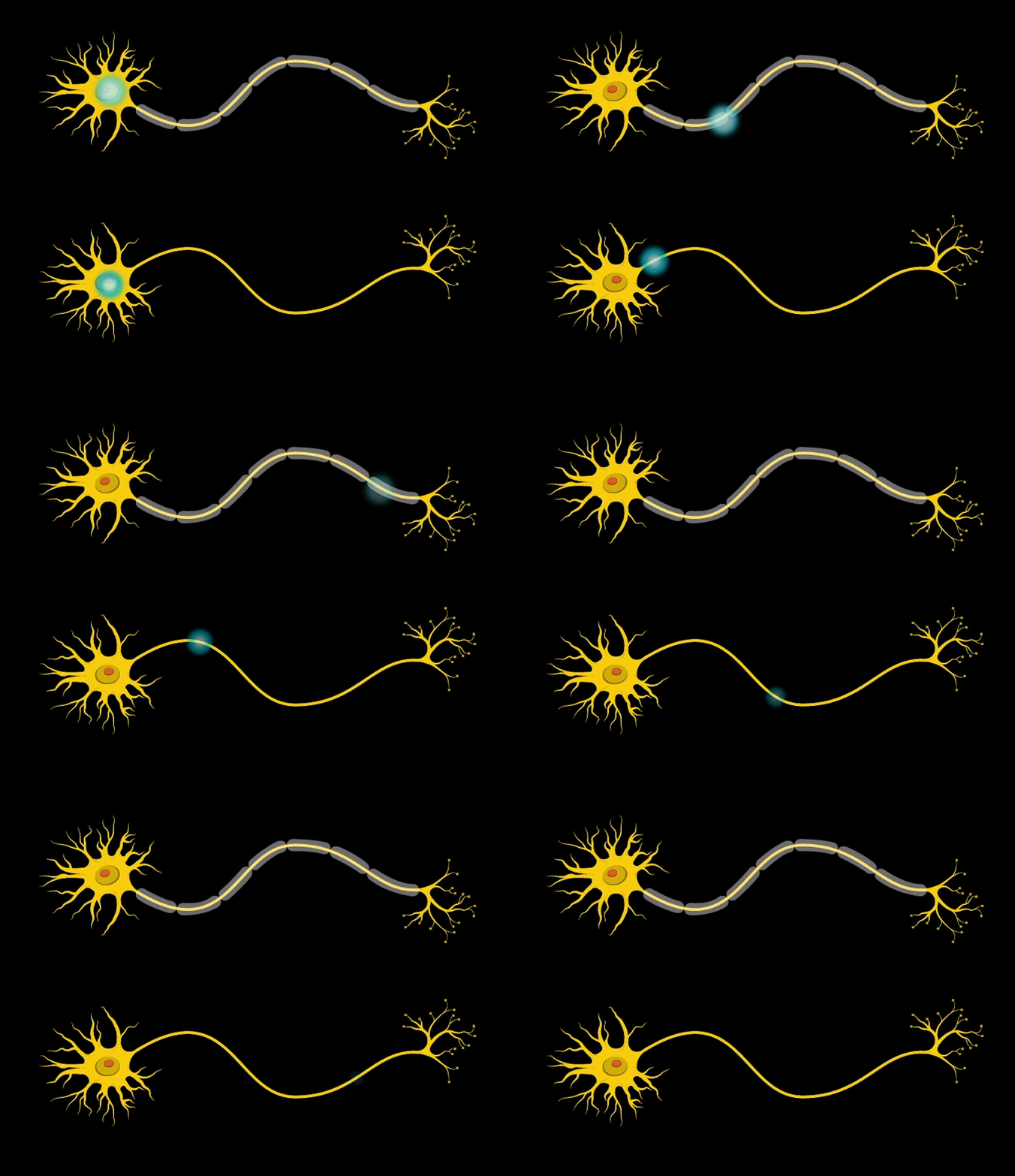
As you sit here right now, think about lifting your right arm but don’t actually do it. That little build up of energy you feel is an action potential sitting at the starting gate ready to take action. If you go ahead and lift your right arm, that’s the action potential lighting up that neural network.
But as you send that electrical charge down that network and lift your right arm in the air, the neural network to wiggle your toes has no charge. It’s useless.
Try to tap your head and rub your belly at the same time. See what I mean?
Herein lies the importance of goal setting when it comes to chronic pain.
Did you know that the first person to ever get pulled over for speeding was going just 7 miles per hour?
Of course you didn’t (unless you read last week’s newsletter).
But in the moment you learned that information, an actual physical connection was formed inside of your brain.
When you set a goal, in that moment, you create an actual physical neural connection inside your brain. And when you think about it, thus sending the action potential down that neuron, you render other networks useless. After all, you can only think about one thing at a time.
If you want to learn a little more about this process, we went over it in more detail in last week’s newsletter.
When we ask you to set a goal, I am not trying to motivate you, I am trying to establish an entirely new neural network in which your pain signal does not exist.
Please take a moment to watch this video so I can explain some of this science.
By establishing a clear goal, we create a new neural pathway—one in which pain is no longer central. Through carefully designed systems and workflows, we reinforce that pathway day after day, giving the brain consistent evidence that a different state is possible.
Over time, that pathway becomes the default. The nervous system no longer has to decide—it simply follows what it has learned. This is why goal-setting is not motivational in our work. It is foundational to lasting pain relief.
Sincerely,
Saint Bartholomew