

The Ten Commandments of Owning a Human Body
Why so many people have fallen into pain and the obvious way out.

For the first six years of my professional career, 100% of my focus was on learning and applying strategies to get the absolute most of out a human body.
That is the job description of an NBA Strength & Conditioning Coach.
I was in charge of taking 15 men to their absolute limit.
What would it take to unleash any and all untapped potential?
If we look at the four categories of human performance,
Posture & Breathing
Strength
Energy Production
Central Nervous System Control
…an NBA player is trying to maximize the output in each category.
This meant daily training, corrective exercises, brutally difficult conditioning sessions, massages, frequent naps, integrating new technology, investing in their nutrition, breaking down film, studying their opponents, hydration, maximizing recovery and so much more.
As a result, treating their pain is easy.
When an NBA player comes in with back pain, there isn’t much of a mystery. When a human body is functioning at such a high level, there are very few possibilities.
In most cases, I could completely eliminate pain on my professional athletes in a matter of seconds.
For the past eight years, I have operated a chronic pain clinic in New York City for mostly non-professional athletes.
For all chronic pain patients, they are simply looking for a strategy to restore their body to sufficient working order.
Across the world, it would appear, that millions are struggling to find this solution…but it’s not hard to find.
Look no further than the people on this planet with the highest functioning bodies…professional athletes.
When I left Los Angeles to open up shop in New York, I was struck by how much worse the non-professional athlete took care of themselves.
I was blown away by what the general population believed a “good workout” was.
Whenever someone would come into my clinic and tell me they were in pain, I would secretly think, “Well, yea! I’m not surprised!”
They had let their body fall into such disarray and for so long, eventually something was going to break.
Many did so unknowingly.
Everyone is doing the same workout.
During our assessments, I always ask them to tell me about their workouts. 99% of men are doing the same thing. They are doing classic bodybuilding splits. They barely do legs (if at all) and they aren’t sweating a single drop.
At the same time, 99% of women are also doing the same thing. It’s always some combination of Yoga, Barre and Pilates.
Sure there are generalized benefits to doing anything in the gym but this is not how you train a body.
As far as I can tell, everyone is falling far below the minimum acceptable requirements to maintain a sufficiently functioning body.
It’s no wonder they are in pain.
The Ten Commandments of Owning a Human Body
The following is an excerpt from my book Athletes Heal Faster. You can get a complimentary copy of this book here.
When I was working for the Lakers, we had one of our point guards come into the weight room one morning complaining of a stiff neck.
He couldn’t turn it to the left.
As an NBA point guard, that’s not good. His job is to see the entire court and set guys up to score. He’s the floor general.
“I must have slept funny.” he told me.
But I was thinking something different…
“What rule did he violate?” I thought to myself.
The human body has a very unique and specific design to it.
All movement and all behavior is not created equal.
Because of this, there are certain rules that come with having a human body.
When you violate one of those rules, the alarm bells sound.
To put it simply, his muscles were contracted in a spasm. The brain sends the signal to lock a muscle on like this when it believes there is some danger. It’s a protective measure.
If we eliminate the threat, the muscle will relax.
“What rule did he violate?”
Life in the NBA is wild. The amount of traveling that these teams go through in a single season is astounding.
After most games, you’re headed right to the airport to hop on a plane to travel to the next city.
I remember those plane rides well.
Flying deep into the night, across the country and landing at some crazy time in hopes that the airport wasn’t too far from the hotel.
I ALSO remember seeing this point guard on every flight hunched over his portable video game unit.
He was a gamer.
He bought some crazy, portable video game contraption to bring on the plane with him so he could play on the flight.
Any time I got up to use the bathroom or stretch my legs, I would look down to the players section of the plane and see that familiar light glowing from his usual seat.
“What rule did he violate?”
I quickly began scanning my mental filing cabinet for an answer.
“The eyes are intimately connected to the muscles of the neck.” a thought popped into my head.
“The rule he violated was playing video games too much and it was his vision that was keeping him engaged in spasm.” I mentally concluded.
“OK, lets try something,” I said out loud.
I had him stand in the middle of the room on one leg.
I stood on his left with a tennis ball and another coach stood on his right with a tennis ball.
He had to look straight ahead and catch the tennis ball if we threw it at him.
I was trying to make him access his peripheral vision.
After a few minutes, I asked him to move around and test the mobility of his neck.
“How does it feel?” I asked.
“Holy S***!!!” he responded, “What the hell was that?!?!”
His pain was gone.
He had violated a rule, we identified which one, and put the body in a position to force himself out of it.
By accessing his peripheral vision, I was getting him out of that pattern of staring straight ahead at the screen that I was assuming the video games locked him into.
By having him stand on one leg, I was forcing himself to re-stabilize his system without the help of his vision.
When I was a 19-year-old college basketball player, this stuff didn’t matter so much.
I could throw my sneakers on in a hurry, run out to the gym floor and be in the middle of a full-blown, Division-1, college basketball practice within seconds of lacing up my sneakers without missing a beat.
Now, at 36, the tides have turned.
At 19, these are more like guidelines.
At 36, they are commandments.
As we grow older, breaking one of these commandments transforms from a slap on the wrist to a mortal sin.
There are simply rules to operating your body and if you abide by them, those painful alarm bells stay silent.
Commandment #1: Never Do Bilateral Exercises
Bilateral means double arm or double leg.
You shouldn’t be squatting.
You shouldn’t be deadlifting.
You shouldn’t be bench pressing.
You shouldn’t be doing pull-ups.
Am I shattering your beliefs?
Am I being too aggressive?
Let’s make this quick and to the point.
Anatomically, the left side and the right side of your body are not the same.
The right side of your diaphragm is WAY bigger, WAY stronger and in a WAY better position to contract than the left side of your diaphragm.
When it contracts (this is your breathing muscle; it contracts when you inhale), a game of tug-of-war begins between the right side and the left side.
This is like a game of tug-of-war between Arnold Schwarzzeneggar and my 2-year old nephew.
I love the kid but Arnold is going to destroy him.
At 20,000 reps per day (on average), during each contraction, Arnold’s strength (the right side of the diaphragm) is so strong that it pulls your body over to the right.
Humans become exceptionally good at standing on their right side but not so good at standing on their left.
This has nothing to do with being right handed or left handed.
It has everything to do with the right side of your body (Arnold!) being way stronger than your left.
Whenever you do a bilateral exercise, meaning using both legs or both arms at the same time, the contention is that you are getting 50% action on the right and 50% action on the left…
…but with this anatomical arrangement, is that possible?
The answer is no.
I’m sorry to wipe out your favorite exercises but according to the rulebook, they are illegal.
Everything you do MUST be unilateral, meaning doing one side at a time.
For a more detailed explanation of this concept, download a free copy of my book Predictable Pain and read the Left AIC section.
This book will give you an in-depth look at the anatomy of the body and I promise you, it will prove to you that bilateral exercises violate the rules of the road.
Download a free copy here: www.4AHPS.com/book
Commandment #2: Rest Every Fourth Week
Exercise is stress.
Calculated stress…but stress nonetheless.
You are intentionally stressing your body in particular areas to elicit the response you want.
All stress counts the same.
Stress from work…
Stress from family…
Stress from bills…
Stress from your favorite football team that keeps running it on third and long and driving you absolutely crazy (I’m looking at you West Virginia!)
At some point, the accumulation of stress hits a breaking point and the body starts to break down.
When you’re training, that breaking point is usually the end of the third week.
If you’re training at the right intensity, you should notice that you’re feeling a little more tired, a little less energetic and your strength may even be going down in your workouts. This should all start happening right towards the end of that third week.
This means you’ve programmed nicely.
This also means it’s time to rest.
In the business, we call that week a “deload” week. In other words, it’s way lighter. Less weight, less reps, way less intensity and way fewer workouts.
During this week we evaluate our client’s progress and begin to craft the next phase of the program.
Professional athletes can sometimes push off their rest week another week or two, but these are people with nothing else to do.
They go to practice at 10am, they are back home by 1pm and they go to the beach or play video games the rest of the day.
For the rest of us who have other things to worry about, the fourth week is the default recovery week.
Commandment #3: Hamstrings, Glutes and Abs Will Solve All Your Problems
The muscles in charge of power…
The muscles in charge of posture…
The muscles in charge of health…
The muscles in charge of athleticism…
The muscles in charge of just about anything you want are the hamstrings, glutes and abs.
Not shockingly, people pay little to no attention to these muscles at the gym.
“But Sean, I do abs every day!” you might be saying.
When I say abs, I mean obliques. The side abs.
Take a look at the rectus abdominis here…
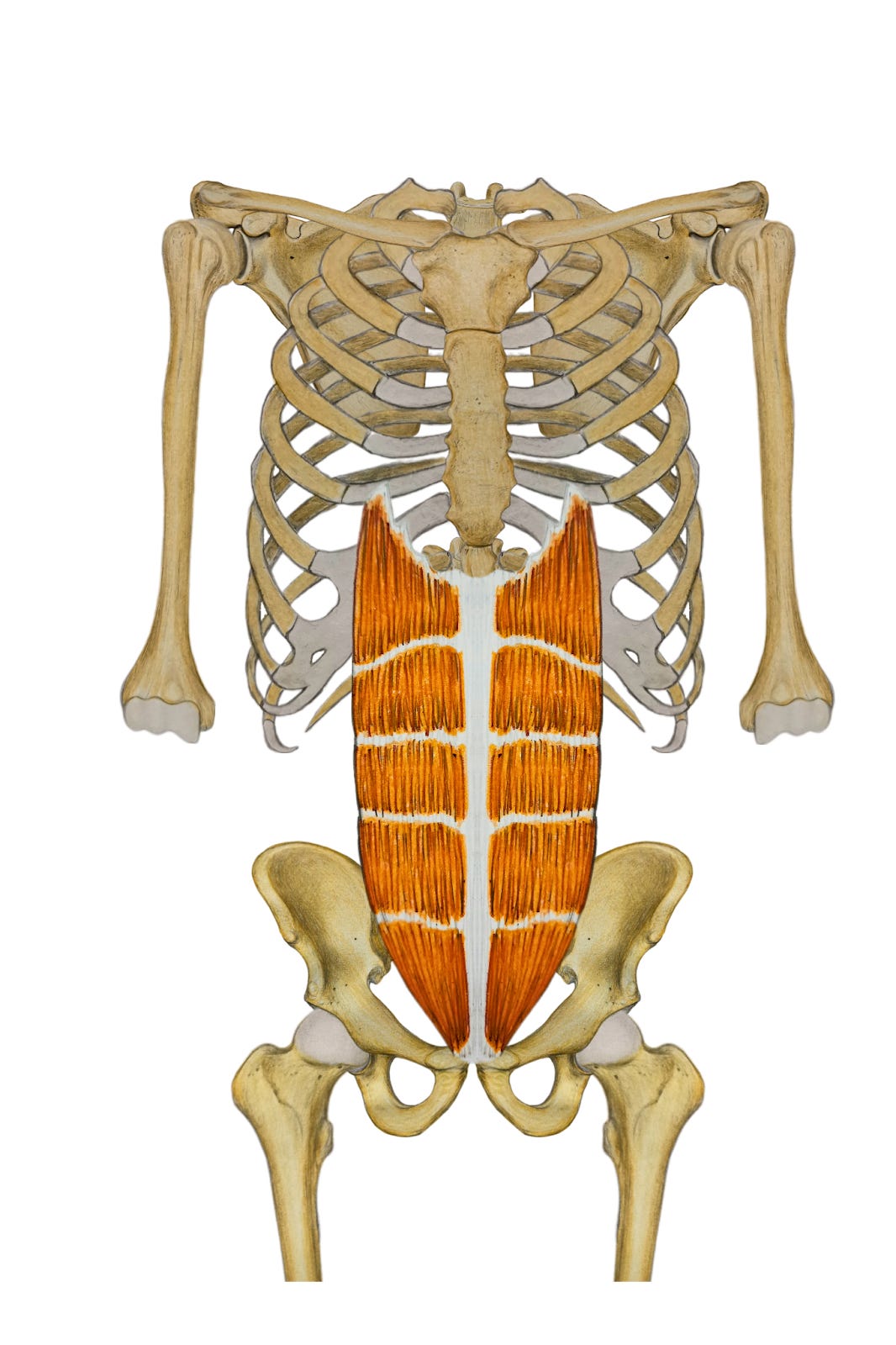
This is the six-pack muscle. This is what everyone wants.
I’m no different. I like having nice looking abs too but these things don’t have enough real estate on the pelvis and ribs to stabilize the core.
Great athletes (the people with the best functioning bodies) have the ability to keep their ribs stacked squarely on top of their pelvis.
When someone says “core,” this is what they mean. Your “core,” is your ability to keep your ribs stacked squarely on top of your pelvis.
The best athletes can do this while maintaining speed, power and endurance.
It is insanely important to your health and performance to be able to produce the same stacked posture.
Look at their two tiny attachment sites. A small point on the ribs and a small point on the pelvis. That’s it.
You can see how bringing these two attachment sites closer together (a muscle contraction) would facilitate that stack BUT you’re just not getting enough bang for your buck.
Now look at the obliques.
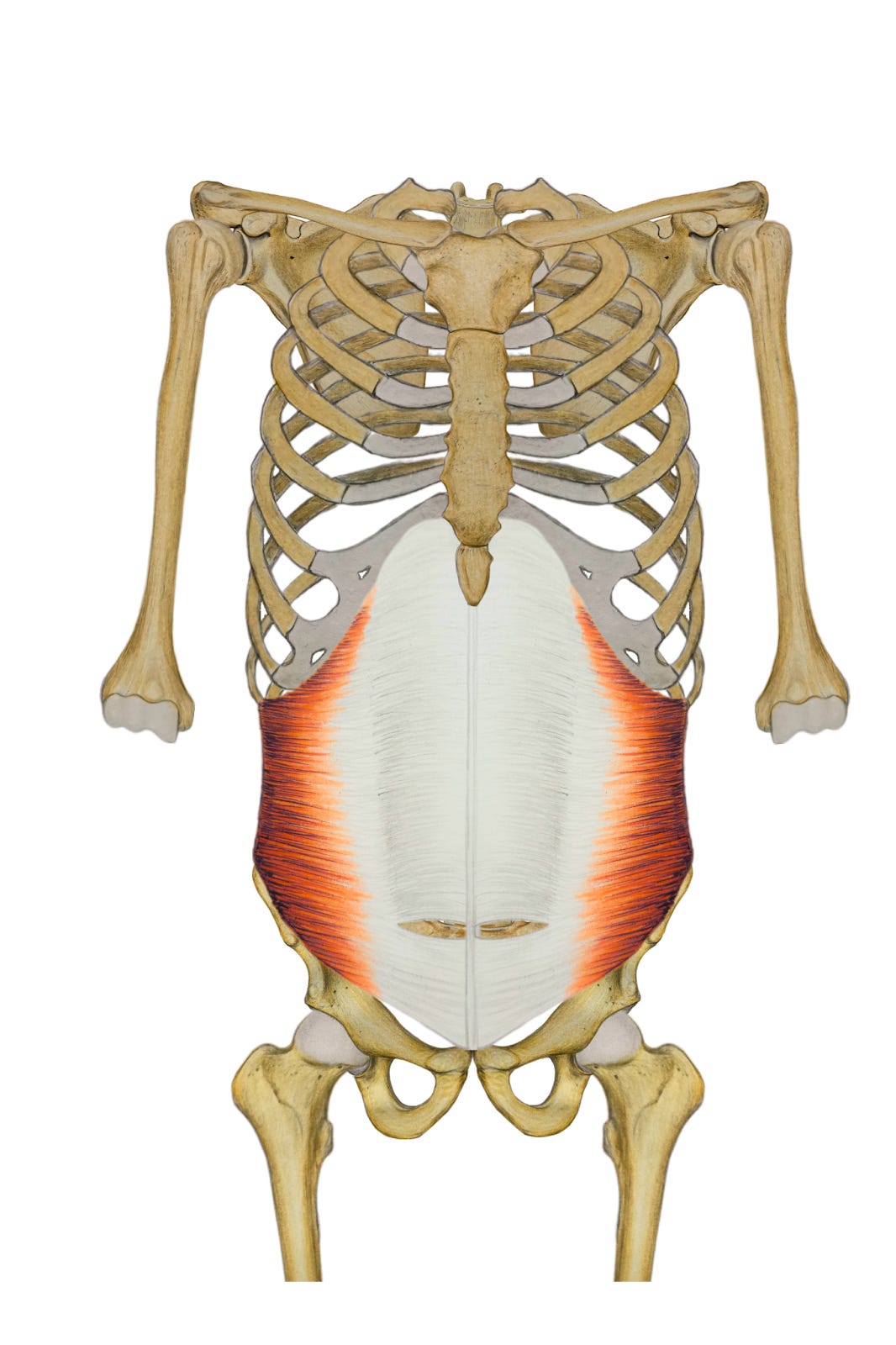
BOOM! Look at all that juicy real estate!
Can you see how the obliques attach to the ENTIRE pelvis and ENTIRE rib cage?
Most pain in the body STARTS when you lose this stack. If I want to get it back and get you out of pain, I’m attacking the obliques with the force of a thousand suns.
Hamstrings and glutes are the most powerful assistants to producing this stack.
If you polled anyone who has ever spent time working with us at our clinic, they would, without hesitation tell you…
“We do so much hamstrings!”
“We do so much abs!”
Commandment #4: You Must Twist
There are three planes of motion that a body can move in…
Front to Back
Side to Side
Rotation
…and yet, most people in the gym only do exercises in the first one. Front to back.
Bench Press
Squat
Deadlift
Dips
Pull-Ups
Sit-Ups
Crunches
…and the list keeps going!
A healthy human has freedom of movement.
Do you know those insanely huge dudes at the gym that are lifting super heavy weights?
Imagine them swinging a golf club!
Pretty stiff, right?
This is the perfect example of someone who has cemented their body in just the front to back plane of movement.
You need all three.
If you’re not doing any side to side or rotational exercises in the gym, you can guarantee that your body is progressively getting stiffer and stiffer with each passing day.
This rule violation is a first class ticket onboard the pain train.
Commandment #5: Move Backwards
As an entrepreneur, if I spend all my time and energy working on marketing, my coaching suffers.
If a basketball player spends all his time and energy shooting right-handed layups, his ability to shoot left-handed layups will suffer.
The healthiest humans are able to do all sorts of different movements. We call this variability.
But if you’re spending every day of your life walking forward, running forward, doing forward lunges at the gym, then your ability to go backwards will suffer.
Remember Rule #3, “Hamstrings, Glutes and Abs Will Solve All Your Problems?”
Well, they are also the muscles in charge of pulling you backwards.
The best athletes do REVERSE lunges.
The best athletes do REVERSE sled drags.
The best athletes spend time walking BACKWARDS on a treadmill.
I’ve even cured headaches in record time by just having someone walk backwards on a treadmill.
Commandment #6: Aerobic Over Anaerobic
At the dawn of the industrial revolution in the late 1700’s, technology began to separate itself from evolution.
Technology develops at such a rapid pace, that the super-slow moving evolution of the human body has not had time to catch up with the modern lifestyle.
It takes hundreds of thousands of years for evolution to set in.
This means we have bodies that are stuck in the pre-technology era.
Hunter gatherer bodies.
Do you know how humans used to hunt for food?
They would go out in teams and try to find a good animal to take down. But the animals were always quicker and faster than they were, so they had to be creative.
They would form MASSIVE circles around these animals and slowly close the gap.
This would sometimes take days to tire the animal out enough to finally capture it.
This means we had to have bodies that could produce energy over a long period of time.
The anaerobic energy system can only produce energy for up to about sixty seconds.
The aerobic aerobic system does not have a limit.
The body you have was not designed to get a bench press PR of 400lbs for one single rep.
It might be a cool achievement to tell your friends, but it’s a violation of the rules.
When you’re exercising and your heart rate is climbing, somewhere around 150 beats-per-minute (depending on your training level), you cross the “anaerobic threshold.”
This is the point where you switch from using the aerobic system to the anaerobic system.
In that moment, you are now training something COMPLETELY different and training above that threshold gets a lot more complicated.
Commandment #7: You Should Sweat During Your Workouts
If you text between sets during your workouts, you can’t train with me.
If you drink a canned beverage during your workout, you can’t train with me.
If you don’t sweat during your workouts, you can’t train with me.
You aren’t working out.
I had a friend that once told me, “I don’t know what to tell you, I just don’t sweat when I workout.”
He told me this for years until one day he asked to join me for one of my sessions.
When we finished, he looked like he just took a shower with all his clothes on.
I belong to a swanky gym in Manhattan and as I’m doing a grueling workout on the treadmill, I look around and see a whole bunch of nothing.
People texting between sets.
People staring at themselves in the mirror.
People socializing.
Look, all that stuff is fine, but you ain’t here to train.
Exercise needs to be difficult.
It must cross a certain threshold of intensity to get what you want out of it.
Sometimes people show up to their first session with us in jeans or khakis.
“You’re gonna learn today,” I think to myself.
If you’re not sweating at the gym, you’re doing something very, very wrong.
Someone Out There is Thinking: “Any exercise is better than none.”
You are correct but you are painting with a very broad brush stroke.
This is not about generalizations.
If you want to be the best of all the ordinary people, then you can use that paintbrush.
Ordinary people are in pain.
This is about transcending ordinary…about moving with perfection.
If you are reading this, it’s time to start thinking about stepping out of the ordinary and into the extraordinary.
Commandment #8: Breathing Matters So Much
When I was playing college basketball, our Strength and Conditioning Coach had us do an exercise called “alligator breathing.”
I remember feeling that a breathing exercise was ridiculous.
But from where I stand today, breathing quite literally might be the single most influential action your body takes.
Anything you do for 20,000 reps every single day is going to have a mighty big impact.
To be blunt, if you can’t breathe correctly, you won’t be able to do anything correctly. It’s that big.
Here’s some key points.
Belly breathing is not good. This is training you to breathe with a disengaged core. Nothing good comes forms from a disengaged core.
You should be able to expand your ribcage 360-degrees with each inhale. Breathing into your back is a major problem for many folks. Add into the equation an anatomical arrangement that is making this even more challenging and you begin to realize the deck is not stacked in your favor.
Commandment #9: You Must Recover
Athletic Restoration is conversation between you and your brain.
You are sending your brain a signal (through intensity) that you want something (whatever muscle you’re working on) to improve.
If you deliver the right amount of intensity, the brain will concede and make that muscle stronger.
That process only happens during recovery periods.
It’s like when they shut down a road overnight to do some construction work on it.
They can’t fix the potholes during rush hour traffic!
Athletic Restoration is the same.
If you are not deliberate with ensuring that you have enough recovery time to create the improvements you’re asking for, nothing will ever change.
When I worked in professional sports, this was our biggest challenge. Where is the recovery time in a 162-game professional baseball season or an 82-game NBA season?
Commandment #10: The Brain Holds a Master Key
Imagine for a moment that you booked an assessment with me at our New York City office.
Nestled into the Manhattan’s Upper East Side, you find our office, take the elevator up and the door opens to a beautiful restoration center.
It smells nice. Like a fancy hotel lobby.
I walk out of my office to greet you wearing nice clothes, a spritz of cologne and I’m eager to get started.
After a brief discussion in my office, seated in nice leather chairs, we walk to the assessment room next door and begin the testing process.
I ask you to lie down on the table so we can get started.
You’re excited to get to the bottom of this thing that’s been bugging you for a while and you really believe this place is the answer!
Imagine how you would feel lying on the treatment table in this scenario.
Now, let’s paint a different picture.
Imagine you walked into our New York City office and the first thing you noticed when the elevator doors opened was a foul smell.
You step off the elevator into a poorly lit office and you see me sitting on the floor eating my lunch.
I stand up, wipe the crumbs from my mouth with my hand, and extend that same hand out to greet you.
You notice that I’m actually wearing flip flops and what appears to be a bathing suit.
My hair is sloppy, I don’t smell particularly nice, the entire office is a mess and it kinda seems like I haven’t paid my electric bill.
Now, to emphasize my point, let’s get a little crazy.
Imagine that the time has come to begin our testing. But instead of taking you into our testing room, you notice that I took the treatment table and placed it right in the middle of a busy New York City street.
I ask you to lie down to begin testing.
Imagine how you would feel lying on the treatment table in THIS scenario.
There is quite a difference, right?
In this second example, you would be tight, stiff, nervous and fearful that you might get run over by a car at any moment.
But in the first scenario, you would be much more loose and comfortable.
If I’m testing your hip mobility in the middle of a Manhattan intersection, I’ll take note that you have “tight hips.”
But do you really have tight hips?
No! You’re just very uncomfortable in your current environment.
When your brain perceives that there is a threat in your environment, it stiffens the entire system to protect you.
It turns on fight or flight.
This is not something we can overlook in Athletic Restoration.
We understand that the brain holds a, sort of, master key to regaining mobility, functional movement and optimal performance.
If you cannot manipulate that master key, then you cannot make a real change to your body.
“But Sean, what about __________.”
“Can I still do my Yoga?”
“Can I still do ___________?”
I get these questions every day when I outline these rules in our clinic.
Look. It is what it is.
Anything outside of these rules is illegal.
I did not design the human body.
I did not make the rules.
This simply comes with the territory.
If you want a body that behaves, that does what YOU want it to do, that moves through your life comfortably and without pain, you don’t have choices. You must follow the rules of the road.
What does that mean for your favorite pilates class? I’ll let you do the math on that one.
Violate these rules at your own peril.
Sincerely,
Saint Bartholomew