

Medicine
Real medicine restores the body. Here's why almost no one is getting it.

On a muggy, winter evening inside the Smoothie King Center in Downtown New Orleans, the starting guard for the Los Angeles Lakers went down with a knee injury.
Without hesitation, the team’s head Athletic Trainer ushered him back to the locker room. Inside, the team’s medical personnel was waiting for him.
The athlete laid down on the training table and the process began. The Athletic Trainer quickly ran his tests. The orthopedic surgeon soon followed. The team’s physical therapist, massage therapist and sport psychologist all joined in.
“MCL sprain,” the ATC suggests to the group, “Doc, can you get him scheduled for an MRI as soon as possible for confirmation.”
The wheels were in motion.
Once the imaging came back clean and confirmed the MCL sprain, the team sprang into action.
On the flight from New Orleans to Chicago, the medical team gathered to create the plan.
The Athletic Trainers would ice down the area and provide red light therapy in the morning.
The massage therapist would then take over to manually remove some of the inflammation and eliminate some tissue build-up in the surrounding muscles.
The Physical Therapist would then step in for some corrective exercises. Building up muscles around the injury, working to support the structure and speed up recovery.
Next, the athlete would move to the weight room where the Strength and Conditioning Coach would train the rest of his body. Even though he would be out for a week or two, he couldn’t afford to fall out of tip-top shape. Alternative exercises were formulated into a plan that attacked different body parts, and new machines were selected to avoid the injured area but still produce an intense training session.
Lastly, the sports psychologist would enter the equation. Making sure that everything in between the ears was remaining focused and in the right place.
In every professional sports setting, this is how injuries, pain and illness are treated.
In the real world…
…however, a very different reality exists.
If you were to have knee pain, what would be your first move?
Maybe, you would wait a little bit to see if it would go away on it’s own.
If that didn’t work, would you Google “good exercises for knee pain?”
Maybe you’d end up down a YouTube rabbit hole or with a completely transformed Instagram algorithm giving you more suggestions and exercises than you know what to do with.
By the time you get here, the professional athlete is already halfway back to full strength.
If you still haven’t found a solution, now you might start asking friends and family for a Physical Therapist recommendation.
Should you choose to see one, this begins an entirely new phase of treatment. You’re sent from one place to the next like a cat chasing it’s tail trying to get MRI’s and X-Rays and going through cookie-cutter programs with mild supervision at best.
If that wasn’t bad enough, you are quietly contending with the insurance companies too…and you may not even realize it.
If your diagnosis isn’t pre-approved by the insurance provider, your Physical Therapist won’t get paid so they are incentivized to fit you into a diagnosis that’s already “on the list,” even if it’s not accurate.
The same thing goes for how they treat you. They can’t use the most up to date science and technology to get you healthy as quickly as possible because the insurance companies don’t recognize those as approved treatments. Again, they are incentivized to give you less effective treatments.
Pair these challenges with the fact that you don’t get access to a team of specialists whose motivations completely align with your own (to get you back as quickly and completely as possible) and it’s a miracle that you end up getting better at all.
Medicine:
The science and art dealing with the maintenance of health and the prevention, alleviation, or cure of disease.
Five years ago, a client of mine began taking blood pressure medication. His doctor had recognized his chronic elevation of blood pressure and prescribed a pharmaceutical to fix it.
Out of nowhere, he started having knee pain.
Was this a “cure of disease?”
Is this the “maintenance of health?”
What really CURES disease? What truly maintains health?
Pharmaceuticals are a blessing to the modern world but so many of the health conditions in our world can be solved completely by REAL medicine…diet, sleep and exercise (we include mental health as well).
When Dr. Terry Wahls was diagnosed with Multiple Sclerosis (MS), it wasn’t long before she was completely confined to her bed. As a physician herself she was discouraged by the effect her medication was having on her. It wasn’t helping her get better, it was just slowing down her demise.
She decided to take matters into her own hands and research who real food might give her the same benefit. She completely reversed her symptoms.
Disease:
A condition of the living animal or plant body or of one of its parts that impairs normal functioning and is typically manifested by distinguishing signs and symptoms.
At Saint Bartholomew, we believe that there are four systems of the physical body that contribute significantly to chronic pain.
Posture & Breathing
Strength
Energy Production
Central Nervous System Control
When any new client comes to our office complaining of chronic pain, we look at the collection of parts to find the answer.
Here is a sample diagnostic that we recently performed:
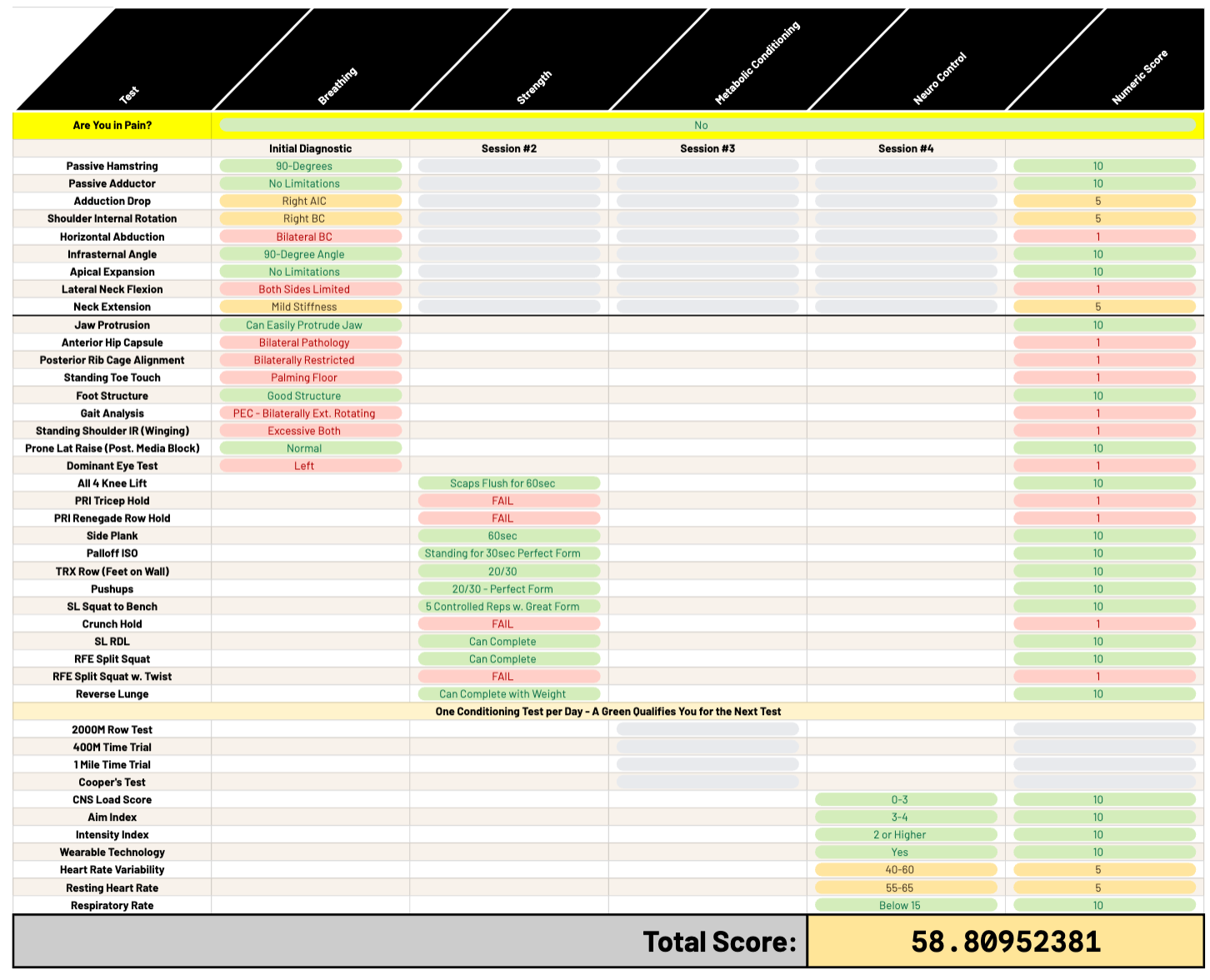
This person scored a 58 out of 100 and you can clearly see the various places where here systems are breaking down.
This individual came in experiencing chronic upper back and neck tension and the red on the assessment is pointing to his inability to breathe properly in that area.
Look at this assessment:
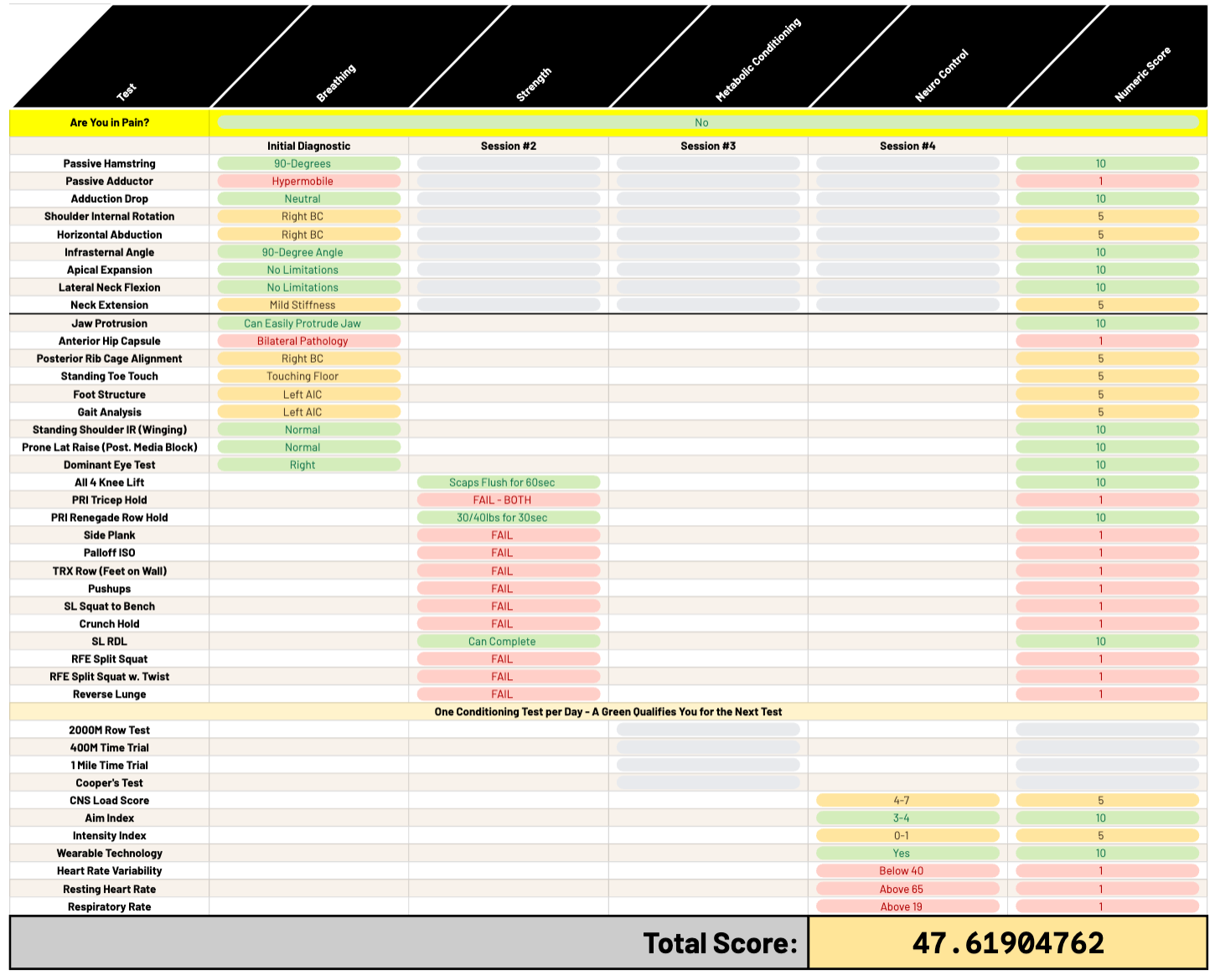
This individual has been to DOZENS of doctors who are prescribing surgical treatments, a litany of pills and various traditional treatments.
But look how painfully weak they are? He failed nearly every strength assessment? You want to see real medicine? Flip each of those tests to green and watch what happens to chronic pain.
If we take all 42 of these tests and get them flipped to green, the likelihood of him still being in pain is nearly zero because his body is operating at such a high level.
That’s REAL medicine.
It’s Time for a New Branch of Medicine
On an average Wednesday at Saint Bartholomew, you will see client’s split squatting heavy weight. You will see others running on the treadmill and some even meditating.
You’ll see 81-year-old teachers starting to do things they thought they’d never do again and you’ll see All-NFL linebackers trying to get that little edge over the Dallas Cowboys.
But what you’re really seeing is medicine.
Medicine as it was initially intended.
Medicine that actually works.
Medicine that truly restores.
You’ll see people prioritizing their health.
You’ll see people making dietary changes.
You’ll see people sweating!
You’ll see people out of breath!
You’ll see people pushing their bodies to get better and most importantly you will see people healing.
Sincerely,
Saint Bartholomew