

genMAX: The Standard for a Pain-Free Body
Restoring the Body to How it was Designed to Work

Halfway through the 2016-17 NBA season, one of our point guards walked into the training facility with one of those pesky “kinks” in his neck.
The kind where you can’t turn your head in one direction for a few days as it slowly dissipates.
For an NBA point guard, this is a major problem. These guys are tasked with “seeing the entire floor” to make the offense go. It is not uncommon to hear broadcasters remark about how certain point guards would have their “head on a swivel.”
Well, in this case, his head was stuck in concrete. There was no movement.
He walked into my office, turning his entire body to face me because his neck wouldn’t move, desperate for some relief.
We walked into the weight room and I asked him to stand on one leg. I stood on his left and another coach stood on his right. We both had tennis balls.
I instructed the point guard to look straight ahead and catch the tennis ball that we would be throwing at random. Sometimes it would come from the left and sometimes from the right. He had to use his peripheral vision to make it happen.
This is not the time to go into the science of this move, but in short, the neck often stiffens up because of a visual system too stuck in focal vision. Accessing the peripheral vision unlocks the mechanism.
After a few minutes of this, we sent him out to practice.
Over the next hour or so, his neck tension melted away and he never missed a single game.
During my time in professional sports, I came up with all sorts of tricks like this.
I developed a list of “rules” that would guide me whenever a player would come in with some sort of pain.
If they came in with right knee pain, I did a Vastus Lateralis release.
If they came in with right lower back pain, I did a left adductor activation exercise.
I thought of myself as some sort of quick-fix wizard.
But when I left professional sports and began working with non-pro athletes, the same problems that I could solve in three minutes in the NBA took me 3 months with the rest of the world.
I couldn’t figure out why this was happening.
During the first year of my clinic, a man came to me with “typical” right lower back pain. But none of my tricks worked.
I was a bit panicked and felt like I had to come up with something for him to do.
“Well, this guy is in pretty bad shape,” I thought to myself, “Let me just put him through a simple workout because people tend to feel better after some exercise.”
So, that’s what I did.
I gave him the most basic workout I could think of.
It had a profound effect.
His pain began disappearing by leaps and bounds.
This was when I first began to realize that the ordinary person’s body had fallen into such disarray, that just doing ANYTHING would start to move them in the right direction.
Working in the NBA, I was working with people who had been finely tuning their body for years. They ate well, they trained with expert trainers, they were hydrated, they meditated and consulted with sports psychologists and they pushed their bodies to become better every day.
But the average person has been drifting from this path for decades. They have an average diet, pull workouts from unqualified YouTubers and maybe meditate for five minutes at a time. Most people we see never REALLY push their body to get better, they do the bare minimum and oftentimes don’t even sweat in the gym.
The average person has been drifting from having a “well-oiled” machine for years. Eventually, something is going to break.
When you are born your body is firing on all cylinders. We call this genMAX. You are operating at your genetic maximum level. If we were to diagram it, it would look like this.
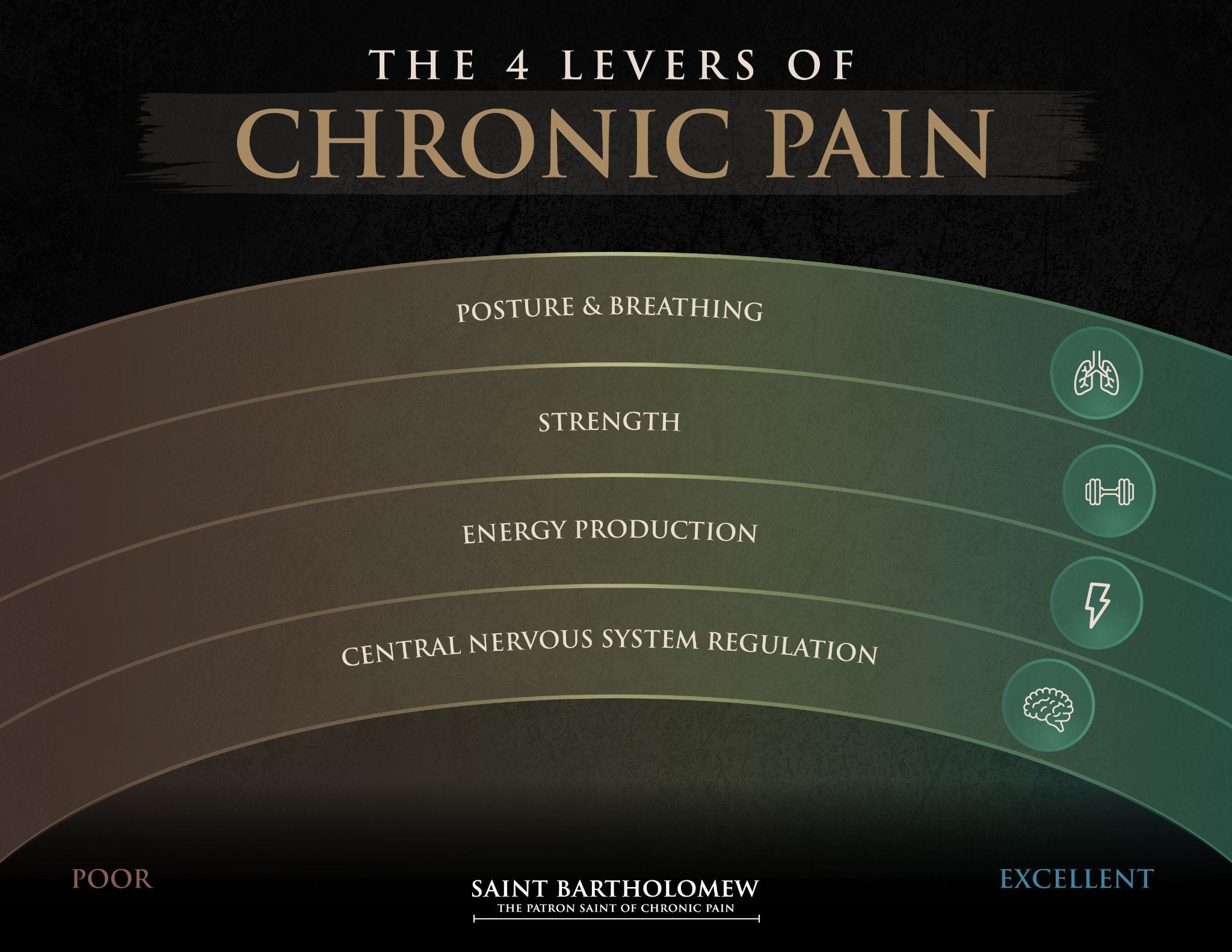
Your genMAX is broken down and measured in four categories (posture & breathing, strength, energy production, central nervous system regulation).
When you are born, each category is on the far right of the spectrum, hovering around “excellent.” You are at your genMAX.
The professional athlete has worked his/her entire life to maintain or even improve their genMAX.
But for non-athletes, your physical body grew less important. Maybe you were more interested in academics, or the arts. You spent your time focusing there and your these categories slowly began drifting to the right.
You didn’t do any one thing wrong, you just focused elsewhere.
But, over time the spectrum kept inching left towards “poor.”
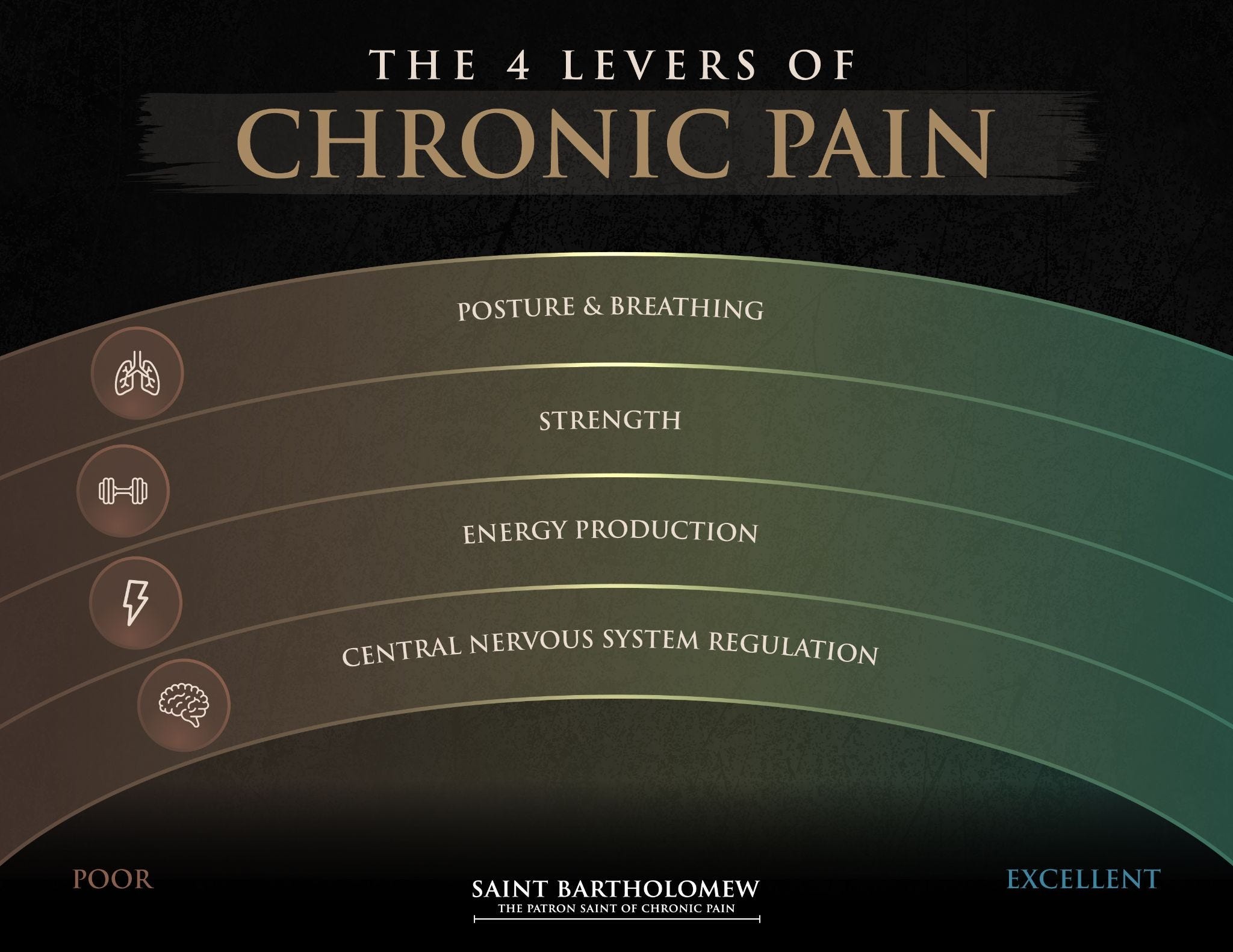
At some point the screws start to loosen.
As you got older, maybe you started feeling a few aches and pains or maybe your gut became less resilient to certain foods and this made you start thinking about your physical body again.
This is when you’ll start researching “exercises for lower back pain,” or “good foods for gut health.”
You find a couple exercises to try or some new foods to introduce into your diet but nothing ever really works. This is because you’re trying to improve just one of these systems.
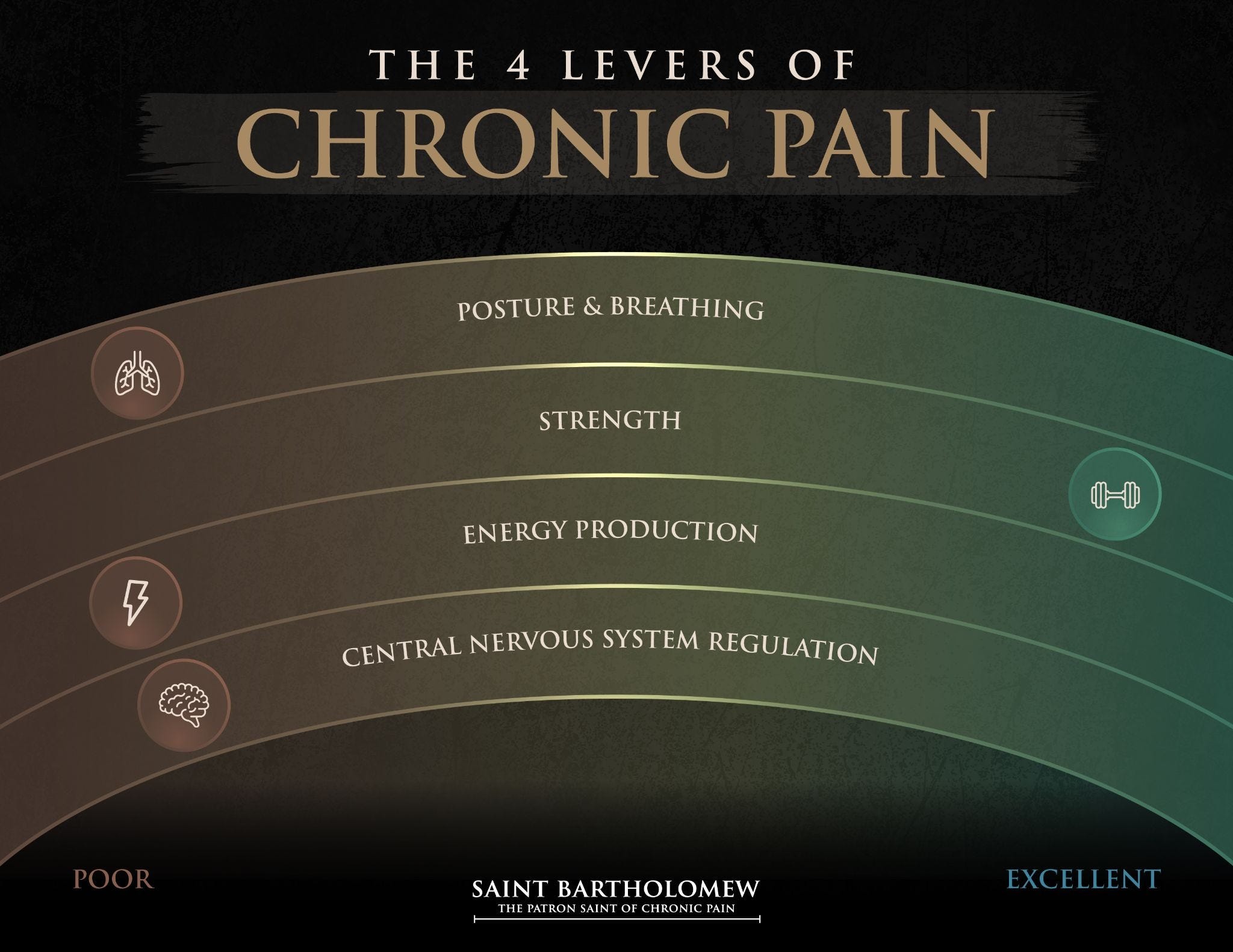
Then you go to the doctor who does the same thing. You go to a back pain specialist who is only looking at your back. Or you go to a gastroenterologist who is only studying your gut.
They will label this as “idiopathic pain,” which means “pain of unknown origin.”
But it’s not unknown at all.
To make learning easier and more digestible, our education system breaks it down into different parts.
This is why we see doctors who specialize in just one thing like brain specialists (neurologists), foot specialists (podiatrists) or eye doctors (optometrists).
But they’ve missed the most important step! Putting it all back together again.
One of the great privileges of my life was to see first-hand, what the best athletes in the world did to ensure their body was operating exceptionally well and then the juxtaposition of seeing how far off the rest of the world was from standard.
It wasn’t hard to see where chronic pain was coming from.
I found myself often thinking, “Well, of course you’re in pain, you haven’t worked out in a decade.”
Or, “Well, of course you’re in pain, your workouts stink!”
When I got my certification as a Strength Coach back in 2011, I thought I knew everything there was to know about fitness.
I thought it was all about doing more, going harder and taking no rests.
I was catastrophically naive.
The depths of the human body are mind-blowingly deep and most of the world is exercising on their own.
That is the equivalent of me stepping into the cockpit of a 747 Jumbo Jet armed with a YouTube tutorial from a guy who looks like he knows what he’s doing.
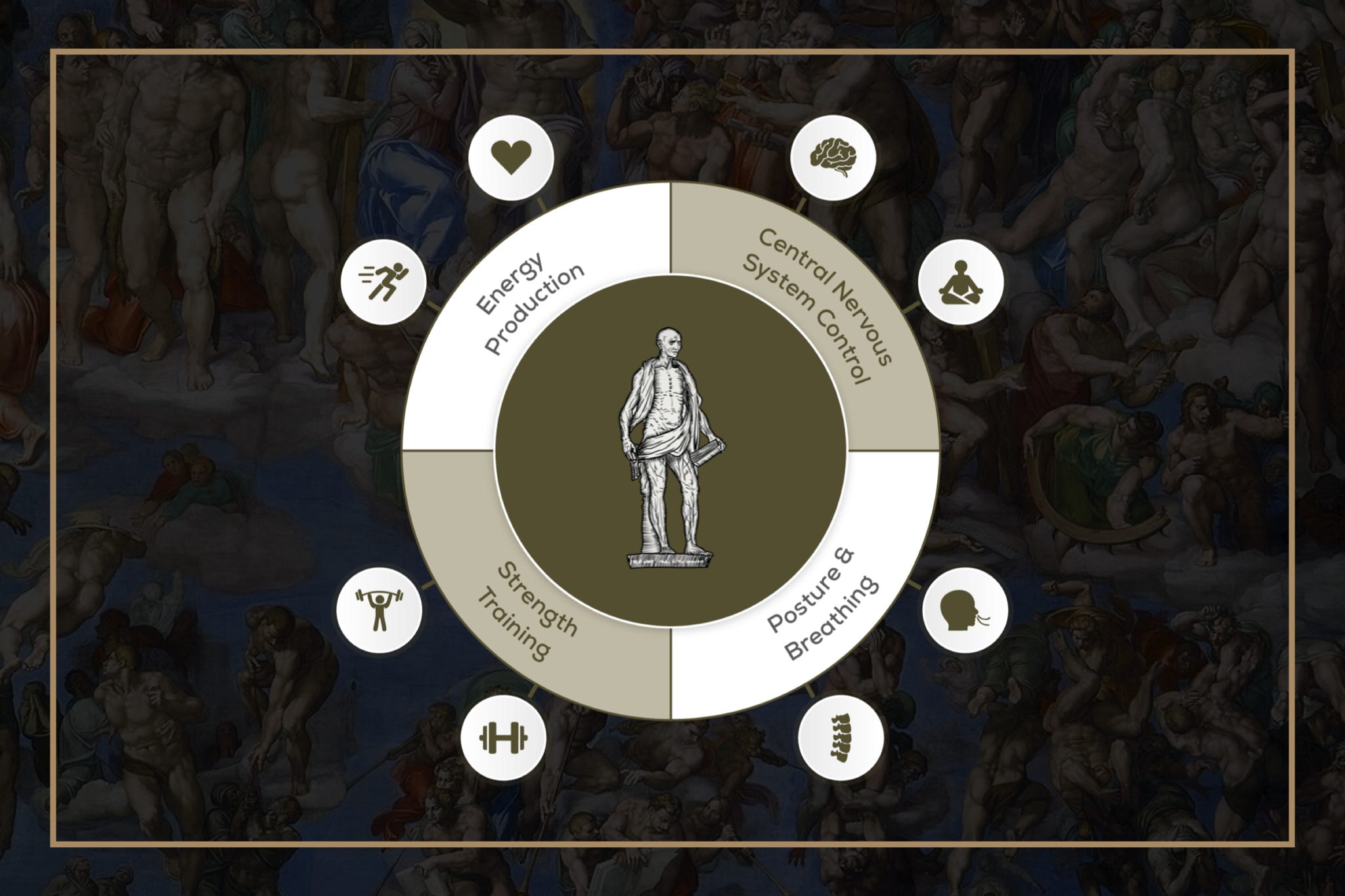
The genMAX System
Our success rate at Saint Bartholomew hovers around 90%. And remember, we see the hardest cases. We see the people who have been in pain for decades, tried every possible solution and are now throwing up one last Hail Mary to see if we can fix it.
And we do.
It’s not because we do anything complex. Rather, it’s the complete opposite. We do the most simple thing imaginable.
We just get the body…the ENTIRE body, back to working form.
The genMAX System evaluates each of your four systems and scores you in each. Based on these results, our team puts together a training program to improve them all.
All of our success rests on one single principle. If we get all four systems functioning exceptionally well, we will reduce the likelihood of you remaining in pain to nearly zero.
The genMAX System was inspired by my work with professional athletes. It was inspired by the glaringly obvious answer that pain cannot survive in a body that operates at such a high level.
The good news is, that you don’t need to come anywhere near your true genMAX, or the intensity and discipline of a professional athlete, to get out of pain, but there are minimum requirements to having a healthy, pain-free body.
It’s kind of like high school. You could work your butt off to get a 100% on the exam but passing is a 70%.
The body is a wonderful, yet extremely complex machine.
It all works together in a beautiful symphony of collaboration.
When we look at chronic pain in isolation, we miss the big picture.
But when you look at chronic pain through the lens of genMAX, you see the solution hiding in plain sight.
Sincerely,
Saint Bartholomew